
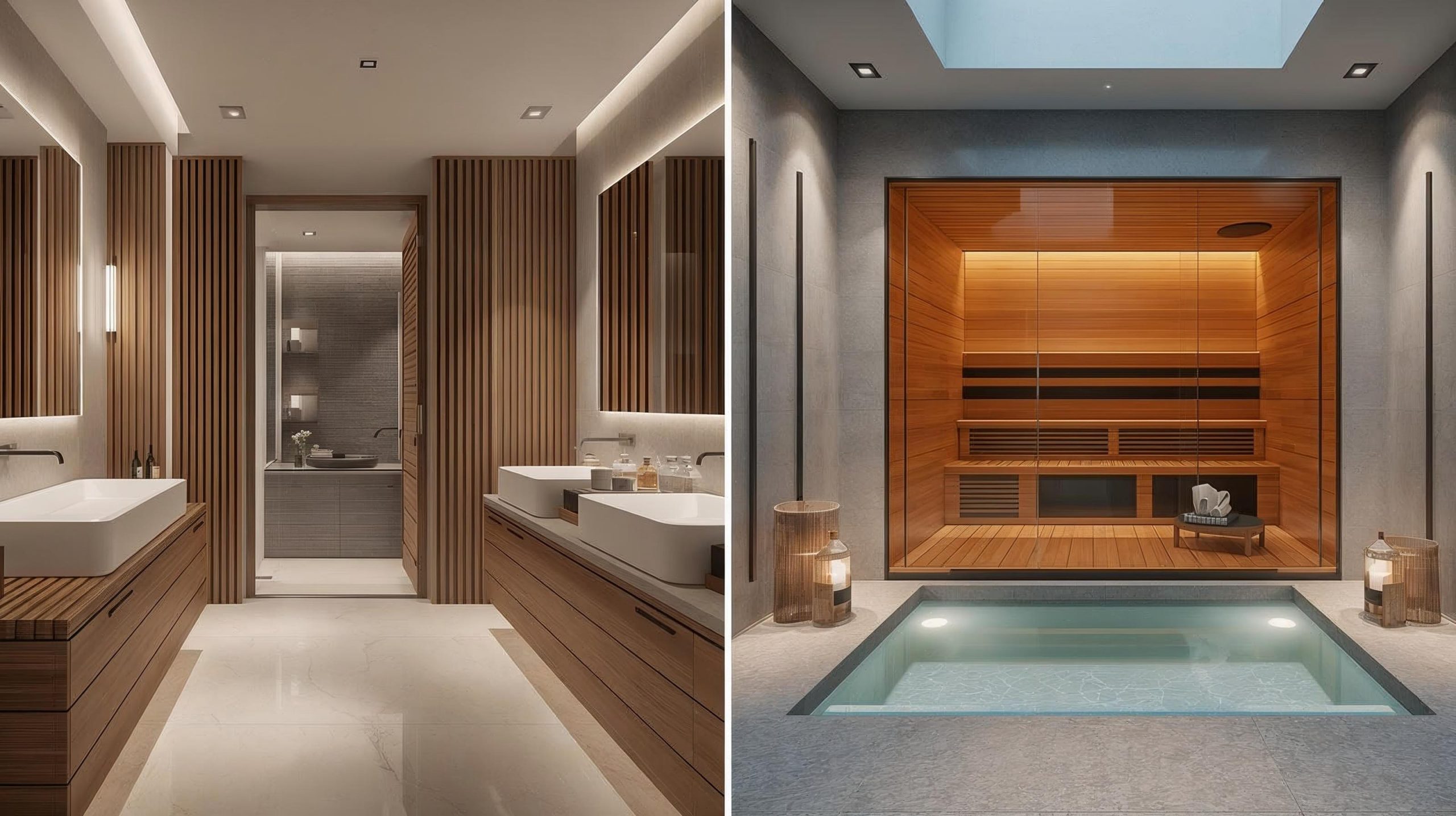
Highlights:
- The price gap is enormous — and intentional. A high-end bathroom remodel runs $20,000–$50,000; a full wellness room addition runs $100,000–$300,000+. That gap exists because they’re solving different problems. One upgrades a functional space; the other builds a dedicated biological recovery ecosystem.
- Mid-range bathroom remodels beat luxury ones on ROI. The 2026 Cost vs. Value Report shows mid-range remodels recouping up to 79.9% at resale, while high-end luxury remodels return only 45–55%. If your primary goal is resale value, a well-executed mid-range remodel almost always outperforms a lavish one.
- The wellness real estate market is accelerating, not peaking. The Global Wellness Institute’s May 2026 data puts wellness real estate at $876 billion globally — up from $151 billion in 2017 — and projects $1.8 trillion by 2030. Homes with wellness features are commanding 10–25% resale premiums and selling faster.
- Sauna ROI is real but market-dependent. Adding a sauna returns roughly 40% in warm climates and closer to 55% in cold ones. With 42% of buyers now calling it a desirable feature, a quality sauna in the right market can be the feature that tips a buyer’s decision — but it won’t pay for itself on paper alone.
- The power of a wellness room is in stacking modalities, not individual features. A sauna alone is a nice amenity. A sauna paired with a cold plunge, red light therapy panels, circadian lighting, and medical-grade air purification is a recovery system. The synergistic effect of contrast therapy, photobiomodulation, and biologically-tuned environments is what separates a true wellness room from an upgraded bathroom with a steam setting.
If you’ve been scrolling through design feeds lately, you’ve probably noticed that “wellness room” has become a phrase thrown around almost as casually as “open concept” was a decade ago. But what actually separates a high-end wellness room addition from a nice bathroom remodel — and is the price difference worth it?
The short answer: a lot more than you might think. The long answer involves heat therapy, contrast bathing, circadian lighting systems, and a wellness real estate market that hit $876 billion globally in 2025 and shows no signs of slowing. Let’s break it all down with the latest 2026 numbers, real feature comparisons, and a clear-eyed look at what delivers the most value.
What the 2026 Data Says About Where Homeowners Are Putting Their Money
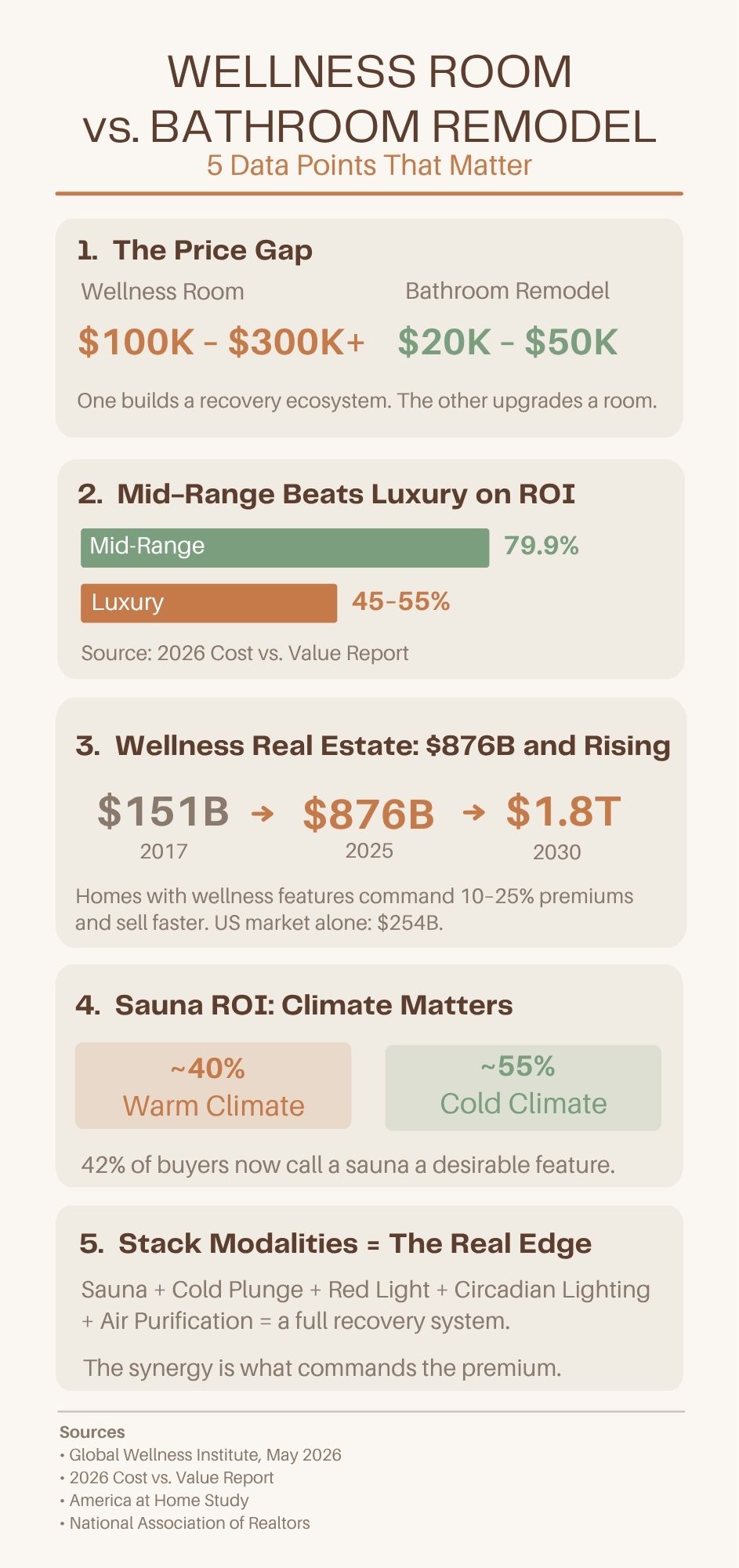
The wellness real estate market is now one of the fastest-growing sectors in both real estate and the broader wellness economy. According to a May 2026 data release from the Global Wellness Institute, the market expanded from $151 billion in 2017 to $876 billion in 2025 and is projected to more than double to $1.8 trillion by 2030. The US remains the single largest national market at $254 billion.
That momentum is showing up directly in how homeowners spend. In the latest America at Home Study, health and wellness have become the primary drivers for home feature preferences, with 60% of consumers now ranking them as their top priority—marking a 17% increase over the last two years. That’s not a niche buyer preference anymore. It’s a market-wide demand signal.
The shift isn’t just aesthetic. As people spend more time at home, they’re realizing their environments profoundly affect their biology — light exposure, air and water quality, temperature regulation, and circadian rhythm alignment. Homeowners are responding by building spaces that do actual biological work. There’s a major shift underway from “beautiful spaces” to “biologically intelligent spaces,” where architecture itself becomes a wellness intervention.
That cultural backdrop is driving a clear split in the renovation market. On one side, you have the traditional bathroom remodel — a functional upgrade that improves aesthetics and livability. On the other, you have the wellness room addition: a dedicated space engineered around recovery, longevity, and daily health optimization. Both are legitimate projects. But they are fundamentally different in scope, cost, and intent.
The Standard Bathroom Remodel: What You Actually Get
Let’s start with the baseline. The national average bathroom remodel in 2026 is $16,500, with most homeowners spending between $8,000 and $45,000 — a 4 to 6% increase from 2025, driven largely by skilled labor shortages pushing plumber rates to $85–$175 per hour and electrician rates to $60–$145 per hour. Angi’s 2026 data puts the typical range at $2,500 to $30,000, with a national average around $12,137 for mid-range projects and luxury full remodels potentially exceeding $80,000.
Here’s how the cost tiers break down for a master bathroom:
- Basic: $15,000 to $22,000 — standard fixtures, basic tile, essential updates
- Mid-range: $22,000 to $30,000 — quality materials, double vanities, improved lighting
- Luxury: $30,000 to $50,000+ — walk-in showers, soaking tubs, heated floors, high-end finishes
A standard remodel — even a high-quality one — typically covers:
Fixtures and Plumbing
A new vanity, updated sink and faucets, toilet replacement, and shower or tub work. Shower installation averages $8,200, with costs ranging from $300 to $15,000 based on complexity and materials. Bathtub replacement runs $2,000 to $9,400. Moving plumbing at all — even shifting a toilet a few feet — can add $5,000 or more to your budget, since it requires opening floors and rerouting drain lines.
Surfaces and Finishes
New flooring, wall tile, and countertops. In 2026, large-format porcelain tile that mimics natural stone dominates for its lower maintenance and competitive pricing. Tile installation labor now runs $12–$22 per square foot — a major cost driver people routinely underestimate. Natural stone and marble remain the prestige choice but require sealing and careful handling.
Layout and Structure
Standard remodels keep the existing plumbing layout in place, which is the single most effective cost-control lever available. Once you start moving fixtures, you’re in a different budget category entirely.
The key thing to understand about a standard bathroom remodel — even a luxury one — is that it optimizes an existing space for comfort and aesthetics. The room still functions as a bathroom. You’re improving the experience of a functional space, not creating a new category of space.
ROI on a Standard Remodel
Here’s where the 2026 data is instructive. Remodeling Magazine’s 2026 Cost vs. Value Report shows mid-range remodels recouping around 79.9% on average at resale — making them one of the best-performing home improvement categories. Mid-range bathroom remodels broadly deliver 65 to 80% ROI in 2026, while high-end luxury remodels return closer to 45 to 55%.
That’s the financially uncomfortable truth about going high-end on a standard bathroom remodel: the more you spend beyond the mid-range, the lower your percentage return. It can still be worth it for quality of life — most people remodel because they want to enjoy the space, not because they’re flipping a house — but it’s worth understanding before you commit.
What a High-End Wellness Room Addition Actually Includes
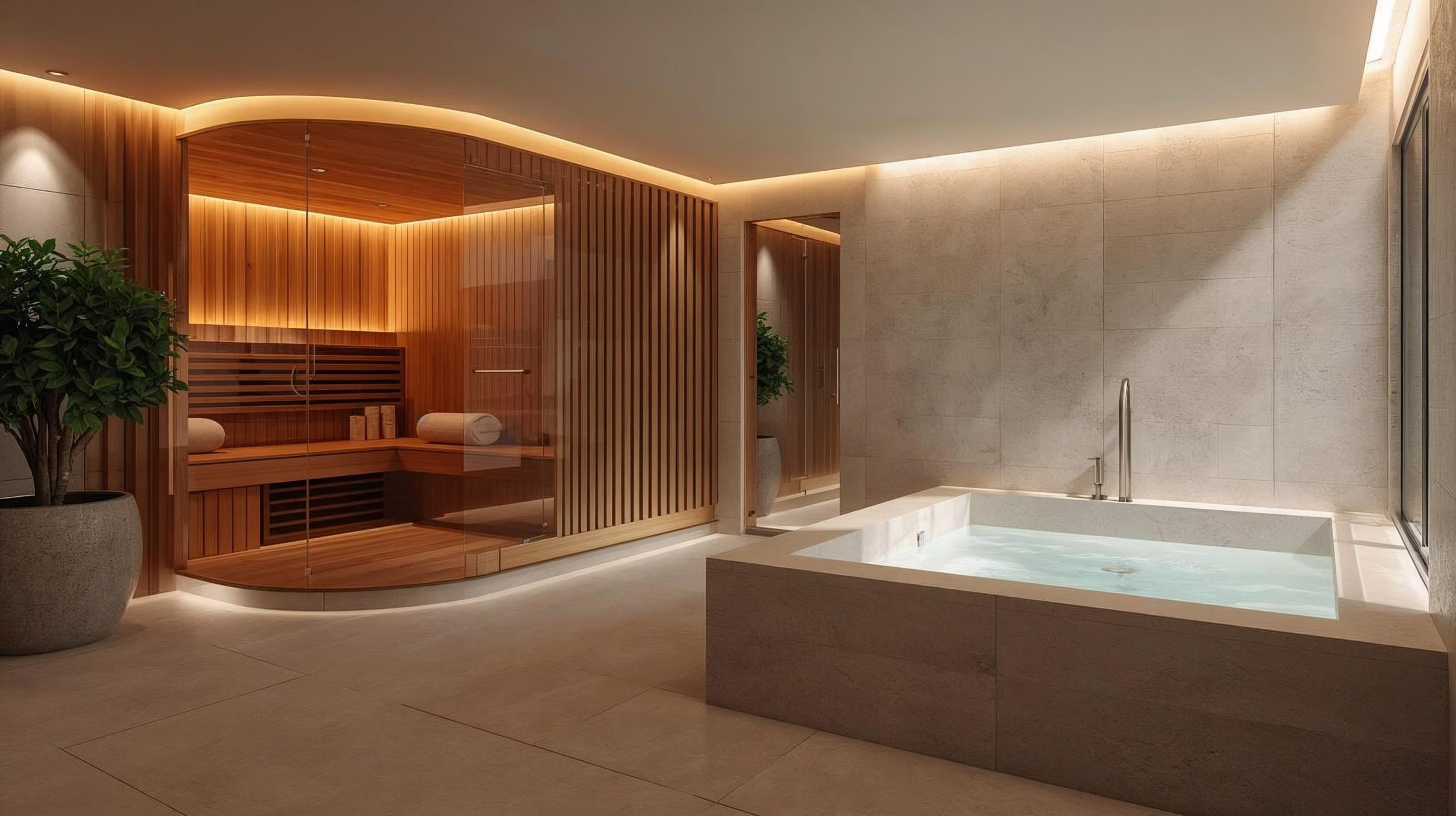
A wellness room is a fundamentally different undertaking. Rather than upgrading an existing bathroom, you’re building or converting a dedicated space — typically 200 to 500 square feet — designed around specific therapeutic and recovery modalities. Think of it as a private spa suite, engineered around biology.
The core amenities for a premium home wellness suite include infrared saunas, cold plunges, steam rooms, red light therapy panels, massage chairs, dedicated gym space, air and water purification systems, and circadian lighting. Each serves a distinct purpose in the recovery and relaxation ecosystem.
Let’s look at each major component with current 2026 pricing.
Infrared Sauna
The sauna is the anchor of most wellness rooms. The complete 2026 pricing guide from Haven of Heat puts home sauna costs at $1,500 to $25,000+, depending on type, size, and installation. A permanent 1–2 person FAR infrared cabin starts around $1,500 as the cost-of-entry point; a premium outdoor cabin setup with professional installation, electrical work, and a cold plunge runs $15,000 to $35,000+.
For a custom, integrated indoor wellness room, expect to budget $7,000 to $15,000 for the sauna unit alone, plus electrical (a dedicated 220V circuit is mandatory), site prep, and finish work. The operating costs are surprisingly manageable — infrared saunas typically add only $5 to $15 per month to your electricity bill. Traditional steam saunas cost more to run and require dedicated plumbing and ventilation on top of the higher unit cost.
One underused savings opportunity: with a Letter of Medical Necessity from a licensed healthcare provider, a sauna may qualify as a medical expense eligible for HSA or FSA reimbursement — effectively saving 20 to 40% depending on your tax bracket.
Cold Plunge
Contrast therapy — moving between heat and cold — has crossed over from elite athletic training into mainstream luxury residential design. A 2026 real estate broker quoted by WLLW put it bluntly: “I have clients who won’t even look at a building unless it has a sauna, cold plunge or steam room. They’re willing to sacrifice square footage to get it.”
Cold plunges at 38 to 50°F have gone mainstream for reducing inflammation, supporting sleep, and improving mental clarity. Unit costs range from $3,000 for a basic tub setup to $15,000+ for premium units with automated temperature control and UV filtration. Budget an additional $1,000 to $3,000 for plumbing connections, drainage, and electrical for chilling systems.
Red Light Therapy
Red light therapy panels deliver targeted wavelengths (typically 660 nm red and 850 nm near-infrared) that stimulate cellular repair, reduce inflammation, and support tissue health — without generating heat. Standalone wall-mounted panels run $500 to $3,000. The more compelling approach for a wellness room is a combined infrared sauna with integrated red light panels, which means you get heat therapy, photobiomodulation, and chromotherapy in a single session. Full-spectrum integrated units from quality manufacturers run $8,000 to $20,000 installed.
Steam Room
A dedicated steam room provides humidity-based therapeutic benefits that an infrared sauna doesn’t replicate — a deeply different sensory experience, better for respiratory and skin benefits. A proper built-in steam room (not a simple steam shower head retrofit) requires a steam generator, full waterproof construction, specialized tile work, and a dedicated electrical circuit. Budget $8,000 to $25,000 for a built-in steam room, depending on size and tile selection. Many high-end wellness rooms combine a dry infrared sauna and a wet steam room side by side, sharing a changing area.
Circadian Lighting Systems
This is where wellness rooms genuinely diverge from even the most luxurious bathrooms. Leading luxury wellness design coverage highlights that tunable LED systems that shift color temperature throughout the day — mimicking natural daylight cycles — are now considered a standard feature in serious wellness builds. These systems can sync with wearables or home sensors to automatically adjust based on the resident’s circadian biology. Basic tunable LED installations run $2,000 to $5,000; fully automated, whole-room smart systems with sensor integration run $8,000 to $15,000+.
Air and Water Purification
In 2026, indoor air quality has become an essential standard of luxury living rather than a nice-to-have. High-end buyers now expect medical-grade air purification that goes well beyond basic HEPA. Water filtration and structuring systems round out the environmental health stack. According to the Global Wellness Institute, nearly 68% of property buyers in North America now consider indoor air quality, natural lighting, and noise control essential decision factors when buying. Wellness room air purification systems run $1,500 to $8,000 installed depending on square footage and filtration grade.
Total Cost Comparison: Running the Numbers
Here’s where the gap becomes very real.
Standard Bathroom Remodel (Mid-to-High End):
$20,000 to $50,000 This gets you a beautiful, functional bathroom with quality tile, a frameless glass shower, upgraded vanity, heated floors, and premium fixtures. Strong daily comfort improvement, solid resale performance.
Luxury Wellness Room Addition (Full Build-Out):
$100,000 to $300,000+ This includes the structural addition or conversion, infrared sauna, cold plunge, steam room, red light therapy panels, circadian lighting, medical-grade air purification, and custom finishes. It’s a dedicated health ecosystem.
For Context on the Structural Shell Alone:
Angi’s 2026 home addition data puts the average home addition at $51,022, ranging from $21,903 to $83,368 depending on room type and finishes. Home additions cost $80 to $200 per square foot for ground-level build-outs and $300 to $500 per square foot for second-story additions. A 300-square-foot wellness room shell at standard build-out quality runs roughly $36,000 to $60,000 — before a single sauna or plunge tub is installed.
The per-square-foot cost climbs sharply when you’re fitting out a space with multiple specialty systems. A basic room addition runs $125 to $250 per square foot all-in. A wellness room, with its electrical demands, specialized plumbing for steam and cold plunge, custom sauna construction, and smart systems, realistically runs $400 to $700 per square foot in total fitted cost.
The ROI Question: Does a Wellness Room Pay Off in 2026?
This is where the data is nuanced — and anyone giving you a simple yes/no is oversimplifying.
The macro picture is compelling. Wellness-centric homes and communities are reporting resale values 10 to 25% higher, according to the Global Wellness Institute, and wellness developments at the middle to upper ends of the market are achieving those premiums consistently. The National Association of Realtors’ America at Home Study found that wellness is the number one purchase motivator for buyers — with many saying they’d trade off square footage or garages to live in a home that better supports their health.
On the sauna specifically, the ROI picture is market-dependent. Adding an $8,000 sauna to a $500,000 home in the Southwest or South returns roughly 40%, while the same installation in colder climates where sauna culture is more embedded returns closer to 55%. Meanwhile, 42% of homebuyers now consider a sauna a highly desirable feature, according to NAR survey data — up significantly from a few years ago.
The honest caveat is that a wellness room is unlikely to deliver a dollar-for-dollar return on a $150,000+ investment. What it does deliver is meaningful market differentiation — particularly in luxury-tier markets where comparable homes are already featuring these amenities. A Corcoran Group broker quoted by WLLW confirmed: “The ‘wellness premium’ is real. Buildings with standout amenities, especially those that feel like a wellness retreat, tend to sell faster and command higher prices.”
Home gym spaces deliver 50 to 85% ROI, and air purification systems return 60 to 80%. The most financially rational wellness room strategy is to build a space you’ll use intensively for years, in a luxury-tier market, with quality installation and permitting — and treat the resale premium as a meaningful bonus rather than the primary investment thesis.
Key Design Differences That Separate Wellness Rooms From Nice Bathrooms
Beyond the features and the cost figures, there are some fundamental design philosophy differences worth understanding.
Intent
A high-end bathroom remodel improves a functional space. A wellness room creates a therapeutic one. Every decision in a wellness room — from ventilation to flooring to lighting — is made in service of a specific health outcome, not aesthetic preference alone.
Systems Integration
In 2026, smart homes are evolving into smart spas, with touchscreen controls, app presets, and AI-assisted climate control that maintains consistent session conditions. LED chromotherapy syncs to circadian rhythms. Wearable integration adjusts lighting and temperature based on biometric data. A luxury bathroom might have Bluetooth speakers and a smart mirror. A wellness room has coordinated systems that actively talk to each other.
Modality Stacking
The power of a wellness room comes from layering therapies with known synergistic effects. Combining infrared sauna sessions, cold plunge immersion, and red light therapy creates a synergistic recovery effect: heat drives vasodilation and sweat-based detoxification; cold shock drives vasoconstriction and norepinephrine; red light stimulates mitochondrial repair and collagen. A bathroom remodel can include a steam shower, but it can’t replicate the full contrast therapy circuit.
Materials and Construction
Wellness rooms require waterproofing standards and specialized materials that standard bathroom construction doesn’t touch. Thermally-treated Scandinavian thermo-wood for sauna interiors (heat-treated to resist mold, cracking, and warping), medical-grade tile for steam rooms, specialized drainage for cold plunges — these aren’t bathroom-spec materials. The construction requirements are closer to a commercial spa than a residential bath.
Buyer Evolution
In 2026, the luxury market’s greatest pitfall is prioritizing wellness language instead of wellness performance. Sophisticated buyers — particularly millennials and Gen Z affluent purchasers — are now asking not just what amenities a home has, but whether those amenities are backed by measurable, integrated systems. A sauna that was bolted into a corner as an afterthought reads differently than one that was designed into the room from the foundation up.
Which One Is Right for You?
If your bathroom is functionally dated and you want to enjoy your home more while improving resale appeal, a mid-to-high-end bathroom remodel is the clear move. You’ll get strong ROI in the 65 to 80% range, immediate quality-of-life improvement, and a space that works better every single day.
If you’re already happy with your bathrooms and you’re investing in your health ecosystem — if you have the space, the budget, and the genuine intention to use a sauna, cold plunge, and red light panel regularly — a wellness room addition is one of the most defensible luxury investments available right now. The macro data on buyer demand, the resale premium evidence, and the individual health benefits all point in the same direction.
The worst outcome is spending luxury bathroom money ($30,000 to $50,000) and getting neither the functional elegance of a well-executed remodel nor the therapeutic depth of a true wellness room. If you’re going to go big, go intentional. A half-built wellness room with one sauna kit crammed into a repurposed spare bedroom isn’t what the market — or your body — is looking for.
Closing Thoughts
The gap between a high-end bathroom remodel and a high-end wellness room addition isn’t just price — it’s category. One improves a functional space. The other creates a dedicated biological infrastructure for recovery, sleep, stress management, and longevity.
Both have a place. The right choice depends on what your home already has, what you’ll genuinely use, your local market, and whether you’re optimizing for daily living, resale value, or both.
What’s clear from the 2026 data is that the wellness room isn’t a trend on its way out. The GWI projects the global market will hit $1.8 trillion by 2030. The homeowners building wellness rooms today are positioning themselves in front of a market that is still accelerating — and buyers who are increasingly unwilling to compromise on the health performance of their homes.
The question isn’t whether these spaces have value. It’s whether they’re the right investment for your specific home, market, and lifestyle — and that answer, ultimately, is personal.